Please like my facebook page if you are viewing this blog.
Professional Sports in the United States
Americans, like many, are very much into their sports! The sports that are popular in the United States are baseball, basketball, hockey, and football.
Each state or region in the United States has professional teams in these sports. Fans are very enthusiastic about their players and teams, and rivalries exist between people and the teams they support. Learn about them before you come to the United States so you will understand how they are played and gain the ability to talk about them with people you meet.
Did you ever wish someone would explain these to you? Read on to learn about them...
- Baseball
- Basketball
- Football
- Hockey
Baseball
Baseball is often called America’s favorite pastime and is a Spring and Summer sport. The final challenge between the best two MLB (Major League Baseball) teams is called the World Series and is played in October.
(Baseball Field – baseball diamond)
Information about the game:
“Aregulation game of baseball is played nine to a side, with each team consisting of a pitcher, a catcher, first, second, and third basemen, shortstop, and right, center and left fielders. The pitcher and catcher comprise the battery; first, second, third, and shortstop players comprise the infield, and right, center and left fielders comprise the outfield. Each team takes a turn at bat, and the goal is to score runs by moving around the four bases. The bases are located at the angles of a 90 foot square (also known as a baseball diamond). Foul lines begin at home plate and extend past first and third base for the entire length of the field.
Each team attempts to score runs against the other team; the team with the most runs after nine innings wins the game. An inning is divided in half, with each team getting a turn at bat and in the field. For each turn at bat, the team is allowed three "outs" before they must take up defensive position in the field. A batter is called "out" when the pitcher gets three "strikes" on him. A strike is a pitch that crosses home plate in the "strike zone" or a pitch that is swung at and missed, or is hit into foul territory. A batter will "fly out" if he hits the ball into fair or foul territory and it is caught by an opponent before hitting the ground. A batter can be thrown out when he hits the ball and it is retrieved by an opposing team member and thrown to the first baseman, who then catches it and steps on first base before the batter reaches it. A runner can be out when the catcher or a baseman receives the ball and tags the plate or the respective base before he gets there. A runner may be tagged with the ball while traveling between bases, or attempting to "steal" a base; this constitutes an automatic out.
The pitcher throws the ball toward the catcher from a slightly raised mound located directly between home and second base, at a distance of 60 feet, 6 inches from home plate. The goal of each batter is to reach base safely after hitting the ball into fair territory. If he reaches first base, the hit is known as a "single"; a second base hit is a "double"; and a third base hit a "triple." A hit that enables him to run around all three bases and come home is known as a "home-run," and scores a point for his team. A homerun may also be achieved by hitting a fair ball over the outfield fence. A batter may be awarded first base if the pitcher delivers four "balls," which are pitches that do not pass through the strike-zone. He may also move to first base if hit by a pitched ball, or if the catcher interferes when he swings the bat. It is the pitcher's goal to deliver the ball with accuracy, and with varying speeds and trajectories, in order to "strike-out" the batter.
When a batter safely reaches base, he must depend on his teammates to hit the ball in such a way that he can advance. For example, he may be able to advance from first to second base on a hit that allowed the batter to take first. He may also attempt to "steal" a base, which occurs when he runs for the next base as the pitcher releases the ball, and reaches the intended base before being tagged out. An umpire-in-chief is positioned directly behind the catcher and determines balls and strikes. One or more base umpires determine whether runners are safe or out from the other three bases.”
Basketball
NBA (National Basketball Association) basketball, often called, ‘hoops’ is played in the Winter and Spring. The final challenge between the two best teams is called the NBA Playoffs and is played in late April and early May.
(Basketball - shooting it in the basket)
Look at this website and learn more about the game – videos
Information about the game:
“Each basketball team consists of five players, and up to five substitutes are allowed. There is usually a center, two forwards, and two guards. The primary ball handler is the point guard, and the top scorer is the shooting guard. The goal is to make the basketball pass through the hoop of the opposing team, and therefore, score points. A successful shot is worth two points; three if it is taken from behind the three-point arc which is 20 feet 6 inches from the basket in international games and 23 feet 9 inches in NBA games. The basketball can be passed, thrown, tapped, or dribbled toward the opposing goal, but it cannot be carried.
A basketball game is played in four quarters of ten or twelve minutes and begins with a "jump-ball." This means that one player from each team stands in the center circle while the referee tosses the ball in the air between them. The players then jump upwards and attempt to tap the ball in such a way that their own team members gain possession of the ball. The players then dribble and pass toward the opposing goal.
Dribbling occurs when a player bounces the ball on the floor and touches it again, without assistance or intrusion of another player. He may continue dribbling as long as he is able, but once it comes to rest in his hand, or he catches it, he must pass it to another player, or attempt to shoot it through the hoop. Many beginners must practice dribbling so they are able to keep their eye on the basket and other players instead of the ball.
Passing and dribbling allows the team to reach a suitable shooting position. Any player may take a shot from anywhere on the court, but the goal is to increase the likelihood of a successful shot. A shot may pass directly through the ring, or it may be bounced off the backboard into the basket. A missed shot is fair game for both teams, who will attempt to gain control of it. The team gaining possession must attempt a shot at the goal within 30 seconds or possession will be given to the opposite team.”
Football
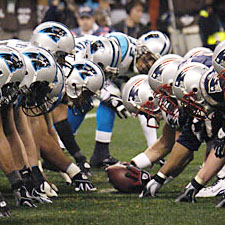
Football (American) is played in the Fall and early Winter. The final NFL (National Football League) challenge between the best two teams is called the Super Bowl and is usually played on the first Sunday in February.
(Football field and players)
Look at this site and learn more about the game – videos
Information about the game:
“American football is a team sport with 11 players on each side. It is played with an oval leather ball that weighs 14-15 ounces and is 11-11.5 inches long. The playing field is grass or turf and measures 53 1/3 yards wide and 120 yards long. It is marked by horizontal white lines spaced 5 yards apart from goal post to goal post, with the 50 yard line marking the center. The goal posts are 100 yards apart, and there are 10 yard end zones beyond the goal posts at each end of the field. The object of the game is to score by advancing the ball toward the opponent's end by running or passing it forward or laterally.
A touchdown is worth 6 points and entitles the scoring team to attempt an extra point by kicking the ball through the goalposts. The scoring team may also try for 2 extra points by completing a pass or running the ball across the goal line. For either attempt, the ball must be started 3 yards from the defending team's goal line. A field goal (kicking the ball through the goal posts) is worth 3 points and may be attempted from the 40 yard line when a touchdown has not resulted but the scoring team is within kicking range of the goal. Where the receiver of the kickoff is tackled and downed, the teams face each other in a line with the possessing team crouched to block the opponents. This is referred to as a scrimmage. The scrimmage is preceded by a "huddle" where the quarterback informs the team of the offensive play.
The team is comprised of a center, a guard, a tackle, two ends, a quarterback, two linebackers, two halfbacks, and a safety that all attempt to advance the ball 10 yards in four downs. If this is not accomplished possession is gained by the opposing team. The team continues its advance until a touchdown is scored or it loses the ball through a fumble or interception.
A professional football game lasts one hour divided into 15 minute quarters. Each half of the game starts with a kickoff, and each team is allowed three time-outs. The game is supervised by a referee, umpire, lineman, field judge, and back judge. Penalties resulting in a loss of 5 to 15 yards may be awarded for several offenses including "offside" (a player crossing the line of scrimmage before the ball is in play), illegal procedure (movement before play begins), "holding" (detaining an opposing player with the hands), "clipping" (blocking an opponent from behind), and pass interference (actively preventing an opponent from catching a pass).
Because football is a contact sport, professional players must wear a helmet with a face mask, a mouth piece, knee pads, and thigh and shin guards. They also wear special cleats and jerseys with the team color and each player's number on the front and back.”
Ice Hockey
Hockey is played in theWinter and Spring. The final challenge between the best NHL
(National Hockey League) teams is called the Stanley Cup playoffs and is played in May.
Look at this site and learn more about the game – videos
Information about the game:
“Play is started by a "face-off," during which the referee drops the puck between the sticks of the opposing centers in the middle of the rink. The other players must remain at least 10 feet away from the center players during the face-off. There are also eight other marked spots on the rink where face-offs take place if play is stopped during the game. The puck remains in play until it is hit across the goal line or the whistle is blown on an infringement. When a goal has been scored, a red light behind the goal is switched on.
The puck may be stopped by a player's stick, hand, body, or skate, but the puck cannot be held for more than 3 seconds. "Stick-handling" refers to using the stick to maneuver the puck. Infringements such as charging, tripping, or body-checking are penalized by sending the offending player off the ice and into a special penalty box for two or more minutes. Fighting is penalized by five minutes off the ice, and deliberate injury is penalized by ten.
The puck is 3 inches in diameter, 1 inch thick, and made of vulcanized rubber, weighing approximately 6 ounces. The hockey stick is made of wood, aluminum, or graphite and has a thin, rectangular shaft from 4.5 to 5 feet long. The blade is 2 to 3 inches and less than 12.5 inches long. It is curved slightly in one direction, allowing for better puck control. The goalie stick widens halfway down the shaft, to a maximum of 3.5 inches. Helmets are worn with or without face guards, as well as gloves, shoulder, elbow, shin and knee pads under a uniform featuring the player's number. Goalies also wear chest protection. Ice hockey skates are made of hard plastic and well padded with lightweight metal blades approximately 2 inches in height.”
 EXCUSE ME, CAN YOU REPEAT THAT?